|
SEO Articles
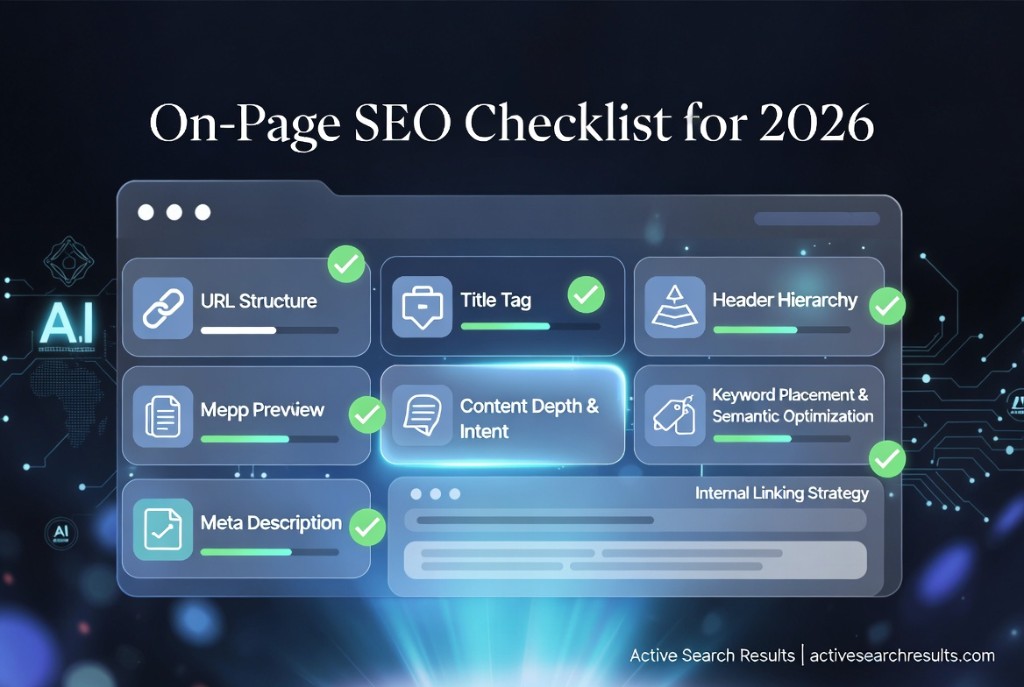
On-Page SEO Checklist for 2026
By: Mark McLellan - Founder/Owner ASR
Prepared with AI-assisted research and writing; edited and approved by ASR.
As a website owner, you’ve submitted your URLs to Google, Bing, and other engines so they get indexed and appear in SERPs. Indexing is simple. Ranking in 2026 is not. On-page SEO—the elements you fully control on each page—remains the single most powerful lever for organic performance when search is dominated by AI summaries, zero-click answers, and hyper-personalized results.
This ultimate 2026 on-page SEO checklist is built for real website owners who need battle-tested, future-proof tactics that deliver measurable results across every major search platform. Apply it systematically and you’ll create pages that rank higher, earn featured positions, keep visitors longer, and convert better.
1. URL Structure – Short, Intent-Focused, and Future-Proof
- Maximum 3–5 words (example.com/best-laptops-2026)
- Primary keyword front-loaded
- Hyphens only, lowercase, no stop words when possible
- Logical hierarchy (example.com/category/subcategory/page)
- Avoid date-based URLs unless content is truly time-sensitive
- Implement self-referencing canonical tags on every page
2. Title Tag – Your Highest-Impact Ranking + CTR Element
- 50–60 characters (AI summaries often pull from titles)
- Primary keyword in first 6–8 words
- Include year only when genuinely helpful (“Best SEO Tools 2026”)
- Use brackets or power words proven to lift CTR ([2026 Review], [Tested], [Guide])
- Every title 100% unique site-wide
- Monitor CTR in Google Search Console monthly and iterate winners
3. Meta Description – Free Advertising in an AI World
- 150–160 characters (mobile still cuts early)
- Primary + secondary keywords naturally
- Strong call-to-action (“Discover,” “Compare,” “Start free”)
- Emotional triggers, numbers, or questions work best
- Zero duplicate meta descriptions allowed
4. Header Hierarchy – The Skeleton of Scannable, AI-Friendly Content
- Exactly one H1 containing the main keyword
- H2 for major sections, H3–H6 for supporting points
- Use question-style H2s to target voice search and “People Also Ask”
- Include semantic variations and entity mentions in headings
- Keep headings descriptive and benefit-oriented
5. Content Depth & Intent Matching – The New Core of Ranking
- 1,000–2,500+ words for competitive topics (depth beats thin content every time)
- Match the dominant intent shown in SERPs (informational → complete guide; commercial → comparison tables + pros/cons; transactional → pricing + CTA)
- Add original data, personal testing, screenshots, or case studies
- Short paragraphs (2–4 lines), generous whitespace, bullet points, numbered lists
- Table of contents with jump links on every page over 1,200 words
- Visible “Published” and “Last updated” dates
- Detailed author box with credentials, photo, and link to author page
6. Keyword Placement & Semantic Optimization
- Primary keyword in first 100 words
- Natural distribution of LSI terms and related entities
- Use bold/italic sparingly for emphasis only
- Zero keyword stuffing—readability score > 70 (Hemingway App)
- Cover “topic clusters” completely so AI can confidently cite your page
7. Internal Linking Strategy – Equity Flow + User Retention
- 5–12 contextual internal links per page
- Descriptive anchor text (never “click here”)
- Link from high-authority pages to money pages and new content
- Build and maintain topical clusters with pillar → cluster linking
- Keep every page reachable in ≤ 3 clicks from homepage
By: Mark McLellan - Founder/Owner ASR
Prepared with AI-assisted research and writing; edited and approved by ASR.
Next
|
|